

“End to end” gets used a lot in accounting technology, and it rarely means what it sounds like. For many firms, it describes coverage; a collection of systems that, between them, touch every stage of the tax process, from collecting client documents through to submitting information to HMRC.
The difficulty is that covering every stage doesn’t necessarily create one efficient workflow. As we explored in the previous articles, much of the administrative burden facing practices sits in the gaps between systems, where information has to move from one application to the next before the following stage can begin.
That’s the problem ApariPro was designed to solve. Rather than adding another application to an already fragmented technology stack, ApariPro brings the personal tax journey together within one platform, so information can move from the client through preparation and review to submission without repeatedly relying on people to bridge the gaps between separate systems.
Coverage isn’t connection
A technology stack can cover every stage and still leave a practice with a disconnected workflow. A firm might have a portal for collecting information, a separate extraction tool, established tax software and integrations that pass data between them, while still needing staff to check or re-key information at each join.
ApariPro takes a different approach. Document collection, data extraction, tax preparation, review, client approval and submission are treated as stages of the same client journey. Information enters against the client record once and moves through the workflow, rather than being repeatedly exported, checked and re-entered at each handoff.
This distinction matters because making individual tasks faster doesn’t necessarily make the overall process more efficient. If software saves time extracting information but somebody still has to move that information into the next system by hand, much of the benefit is lost at the join.
HMRC compatibility is only the final part of the journey
Having software capable of submitting Making Tax Digital updates to HMRC is clearly essential, but submission is only the final stage of a much longer process. It says little about how efficiently client information was collected, organised and prepared before it became ready to submit.
A firm can therefore be technically ready for MTD while still operating a highly manual workflow behind it. Documents may arrive through several channels, information may move between applications, and staff may still spend considerable time establishing what’s been received and what remains outstanding.
ApariPro approaches the problem from the other end of the journey. The process begins with the client and the information the practice needs from them. Documents and relevant tax information are brought into a connected workflow where they can be organised and prepared for accountant review before progressing through approval and, ultimately, to HMRC.
The value of the platform isn’t confined to filing. It lies in reducing the administrative work required to get from the client’s information to that point in the first place.
The real test is what happens at the joins
A genuinely connected workflow is defined as much by what it removes as by what it does. Information should enter once, against the right client record, and progress through the tax process without being manually carried between applications.
This is where ApariPro differs from simply assembling a collection of point solutions. The client record provides continuity through the process, so information stays connected as it moves from collection and preparation into review, approval and submission. Professional judgement stays exactly where it belongs; with the accountant, while the administrative work required before that judgement can be applied is reduced.
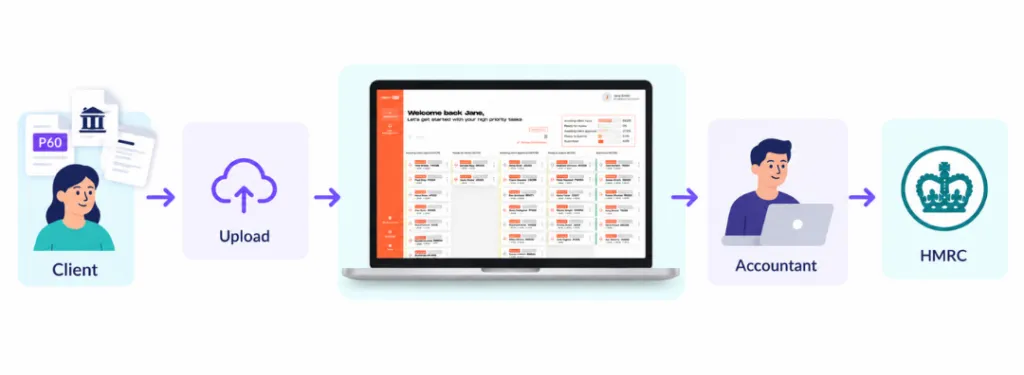
One journey, six stages
In practice, that journey looks like this:
-
The client uploads documents: P60s, bank statements and receipts through a simple portal.
-
Information is extracted automatically and organised against the client’s record.
-
The accountant reviews and prepares the tax position using data that’s already structured, rather than re-keying it.
-
The client approves the figures directly in the platform.
-
The return is submitted to HMRC from the same system.
-
The client record carries forward, ready for the next quarter or the next year.
Nobody needs to export a file, email a spreadsheet, or manually confirm that one system’s output matches another’s input. The stages are steps in a single process rather than separate tools stitched together after the fact.
MTD makes this more important, not less
Making Tax Digital for Income Tax raises the stakes on this approach, because processes previously concentrated around an annual Self Assessment cycle now need to support information collection and reporting throughout the year.
For firms relying on staff to bridge multiple systems, that added frequency magnifies existing inefficiencies. A few unnecessary interventions per client might be manageable once a year; repeated across a client base and a quarterly cycle, they start to consume real capacity.
ApariPro is built to address that operational problem rather than treat MTD as a standalone filing requirement. The same workflow supports existing Self Assessment work while providing the digital process MTD requires on a single platform – without forcing firms to run two separate, fragmented systems side by side.
MTD readiness, in other words, isn’t just about whether a quarterly update can be submitted successfully. The more important question is whether the process producing that update can run efficiently, and repeatedly, at scale.
Get a more connected workflow for your practice
The accounting technology market has become very good at solving individual problems. The unintended consequence is that firms can end up with an increasingly sophisticated collection of tools, while their people still provide the manual connections between them.
For firms reviewing their personal tax technology, there’s a simple test: count how many times the same piece of client information still needs to be manually touched on its journey through the practice. If people remain responsible for connecting every stage, the workflow stays fragmented – no matter how sophisticated the individual systems are.
ApariPro is designed to change that equation: one journey, from client to HMRC, with nothing lost at the joins.